The percentage of our retail client accounts that were profitable in the last, most recent, four quarters was: | Q2-2026 : 29% | Q1-2025: 31% | Q4-2025: 29% | Q3-2025: 40%. Contracts for Difference (CFDs) are complex instruments with a high risk of losing money rapidly due to leverage and may not be suitable for all investors. You should not trade with money you cannot afford to lose. These percentages are for illustrative purposes only and do not indicate future performance.
Unlock the potential of index trading with our insightful guide and actionable tips.
Learn how to analyse index movements, execute trades,
and make informed decisions.

Indices provide a unique way to gain exposure to global financial markets. Assuming you already know what indices are and how they are composed and calculated, it is time to dive into how you can trade them effectively.
By itself, an index is not a tradable financial instrument; it is only meant to measure how a basket of stocks performs. Still, there are various ways you can gain exposure to the performance of an index in the market.
With Friedberg Direct, you can trade indices via CFDs, which are leveraged products. CFDs are financial derivatives that allow traders to speculate on underlying asset price changes without taking any ownership of the asset.
CFDs have no trade restrictions such as Contract amount or expiry dates. By trading indices via CFDs, you can also make profits when prices rise or fall.
Friedberg Direct provides tradeable index-based CFDs via two different contract types:
Index Futures CFDs
Index Futures CFDs are based on the respective index futures contracts, which have broader trading hours than the index itself. They feature transparent pricing and are traded without commissions or any management fees. They are available to all kinds of traders.
You can trade a wide range of global index CFDs at Friedberg Direct with attractive trading conditions such as flexible leverage, multiplatform functionality, a responsive technical support team, and local regulation.
Here is a summary step-by-step guide to learning how to trade stock indices.
Choose a Reliable Broker
One of the most critical components of a successful trading endeavour is choosing a broker that is right for you. The first step would be checking whether your preferred broker is regulated in Canada. You should also check the trading conditions the broker provides, deposit/withdrawal methods, available trading platforms, technical support, etc.
Open and Fund Your Trading Account
Open a live (real money) and demo account. At Friedberg Direct powered by AvaTrade technology, you can trade indices by opening a WebTrader, MT4, or MT5 account. Some indices are exclusive to the MT5 platform, so you need to consider this before deciding on the platform you wish to use.
You can also choose different account types, such as Retail, Professional, and Islamic (swap-free), according to your specific needs and qualifications.
You will need trading capital to trade with. You can fund your Friedberg Direct powered by AvaTrade technology account using safe and convenient methods, such as debit/credit cards and wire transfers.
At Friedberg Direct you can hold your account balance in CAD or in USD. The minimum deposit requirement is 250 and applies to your account base Currency: CAD account – CAD $300 or USD account – USD $250
Choose the Index You Wish to Trade
It is now time to choose the index you wish to trade. When choosing an index to trade, the factors to consider include trading conditions, trading hours, and your risk appetite.
You can browse all the different Friedberg Direct powered by AvaTrade technology trading conditions of available indices here.
Open a Trade
After deciding which index to trade, it is time to open a trade position in the market. You can either buy (go long) when you expect prices of the underlying index to rise or sell (go short) when you expect prices of the underlying index to fall.
Below we will explore the different factors that influence the prices of indices. You can also visit our Education section to learn about different technical analysis methods to help you trade indices better.
Monitor your Trade
After opening your trade, you need to monitor it. In general, it is recommended that you have a clear plan before you take a trade. This means having both a stop loss and profit target in place.
The nature of the composition of indices means that there are likely to be varied factors that may trigger price volatility. For instance, a major change in management in a single constituent company could influence the price of the entire index.
Trade monitoring allows you to assess whether your trade position is performing according to expectations or if you need to take any decisions and actions to reduce your risk exposure or enhance your potential profitability.
Close the Trade
Your trade will automatically close when your stop-loss or take-profit order is achieved.
The stop-loss order helps to limit your losses when prices go against you, whereas the take-profit order helps to secure your profits. Depending on your trading strategy and plan, You can manually close your trade position anytime to cut losses early or book partial profits.

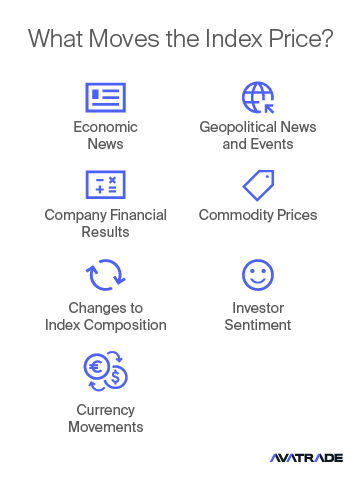
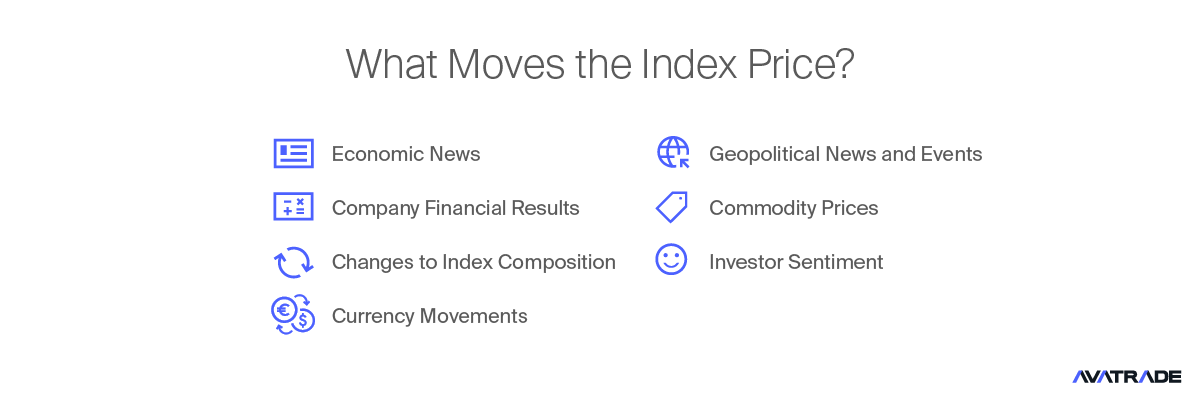
Here are some of the factors that influence the prices of indices:


Economic News:
Indices are benchmark instruments. Their prices can be influenced by broad economic news and events such as changes in interest rates, inflation numbers, Central bank announcements, employment numbers, and other economic indicators.
Company Financial Results:
Company financial results provide essential information such as revenues, profits/losses, growth rates, dividends, future guidance, company announcements, and other pertinent information that shareholders need to know.
Unlike earnings reports, which are scheduled, a company may make surprise announcements that may influence its stock price and the overall index. Some major company announcements can include changes in management, regulatory approvals, expansion into new markets, mergers and acquisitions, lawsuits, etc.
Changes to Index Composition:
Indices are rebalanced periodically according to their composition criteria. This rebalancing can see changes in the constituents' weights and the addition and removal of some stocks. These changes can lead to price movements of the overall index.
Currency Movements:
An index can be influenced by exchange rate changes depending on its constituents. For instance, if an index comprises companies that generate their revenues and profits in US dollars, the price of the constituent stocks may rise or fall depending on the currency's strength.
Geopolitical News and Events:
As benchmark financial instruments, indices’ prices are susceptible to local and cross-border political risks. Geopolitical news and events such as trade agreements, trade wars, elections, and immigration policies can trigger uncertainty among market participants and impact index prices.
Commodity Prices:
The prices of important commodities, such as oil and gold, can influence index prices. Oil, for instance, can impact the cost of living and level of consumption in the market. This can consequently impact the revenues and profits of various companies and thus affect index prices.
Investor Sentiment:
Investor sentiment is the collective feeling that market participants have towards an asset. It can be influenced by the factors above or even rumours fuelled by social media.
When investors are feeling bullish (optimistic), they tend to express that in the market by creating demand which triggers higher index prices. Similarly, if they feel bearish (pessimistic), this can lead to lower prices.
Indices are unique and potentially lucrative financial assets. Here are some of the top strategies that indices traders use:
Visit the link to learn more about indices trading strategies.
Index trading times depend on the exchange open hours where they are listed on. It is typically where their constituent stocks are traded and when there will be more activity on the index.
Here is a table of some of the traditional trading times of some popular indices:
| Indice | Country | Index Trading Hours (Mon-Fri GMT) | CFD Indices Trading Hours (Mon-Fri GMT) |
| US_500 | US | 9:30-16:00 | 17:00-15:59 |
| US_TECH100 | US | 9:30-16:00 | 17:00-15:59 |
| DAX 30 | GERMANY | 03:00-15:00 | 19:15-14:59 |
| CAC 40 | FRANCE | 03:00-11:30 | 001:00-16:59 |
| UK_100 | UK | 03:00-11:30 | 01:00-16:59 |
| NIKKEI225 | JAPAN | 19:00-21:30 and 22:30-01:00 | 18:30-01:24 and 01:55-15:44 |
| CHINA A50 | CHINA | 20:30-02:00 | 20:00-03:29 and 04:00-15:44 |
* While these are the official exchange open hours, it is important to point out that the bulk of indices trading takes place in derivative markets such as futures. This technically means that they can be traded outside exchange hours, with minimal breaks.
With CFD trading, your profits and losses depend on your contract size as well as the price difference between trade entry and exit. At Friedberg Direct powered by AvaTrade technology, beginners can trade fractional contract sizes of as little as 0.01 on their preferred indices. Experienced traders can use leverage to boost their exposure in the markets further.
Let us have a look at how to read a stock market index.

In the example quote shown, the first price is the selling price, while the second price is the buying price.
If, for example, you decide to buy 10 units of the US500 index, the position’s value will be $45297.5 (4529.75*10).
If you are trading with a leverage of 100:1, you will only require $452.975 margin capital to open that position.
After a period, let’s assume your price prediction was correct and the index is now trading according to the new quote of $4700; your position will now be worth $47000 (4700*10).
Your gross profit will now be $1702.5 ($47000-45297.5). Your net profit will vary slightly depending on the spread as well as positive/negative swap rates if the position was held overnight.
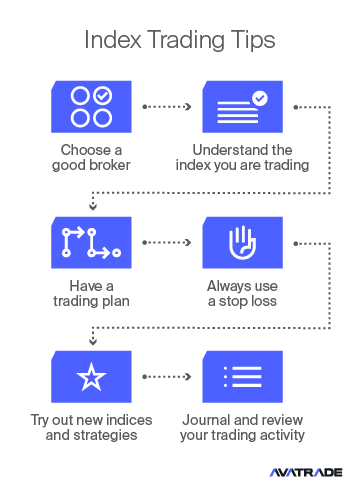
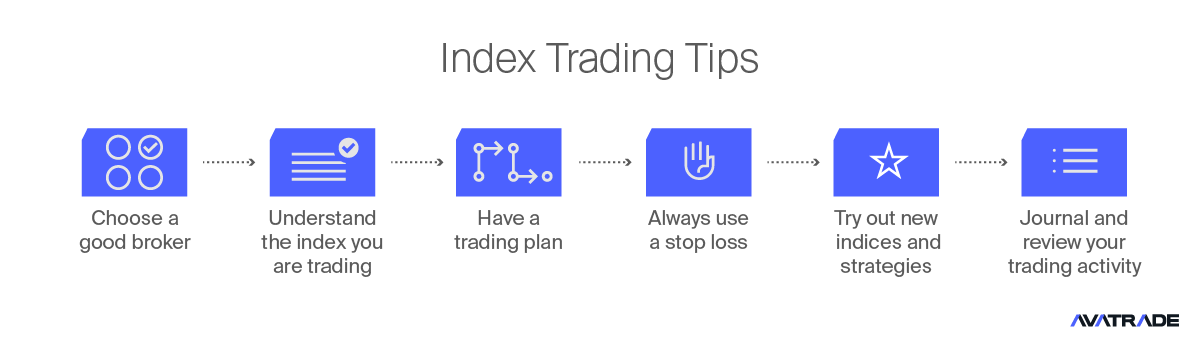
Here are some important index trading tips for both beginners and experienced traders:


Choose a good broker
One of the most critical components of a successful trading endeavour is choosing a broker that is right for you. The first step would be checking whether your preferred broker is regulated in Canada. You should also check the trading conditions the broker provides, deposit/withdrawal methods, available trading platforms, technical support, etc.
Understand the index you are trading
It is essential to understand the type of index you wish to trade. The more knowledge you have of the index and the factors that impact it, the more likely you will identify opportunities and risks far easier.
Some key index information you should learn about: Composition structure, Constituent weights, Major price influencers, Maximum leverage level, Open hours and other relevant trading parameters
Have a trading plan
A trading plan will include your strategy and several other trading objectives to guide your market decision-making. For instance, a short-term index trader may plan to take trades during periods of high volatility, such as exchange open hours or during the release of major company earnings reports.
A good trading plan will allow you to take advantage of opportunities in the market objectively and help achieve a high level of discipline and consistency.
Always use a stop loss
Indices can be volatile and highly trending assets. This means that a wrong price prediction can lead to significant losses. It is, therefore, important to always use a stop loss that will limit your losses in case prices go against you.
Try out new indices and strategies
Indices are a vast market, so plenty of trading opportunities exist. Be sure to explore new indices and test new strategies using a demo account.
At Friedberg Direct, for instance, we have a vast selection of major and well-known indices, but we also have a great selection of minor and specialised indices such as: China Internet, NFT giants, Cannabis Index, Remote Economy, and many more.
Journal and review your trading activity
Successful trading requires accountability. It is, therefore, advisable that you keep a thorough journal of your index trading activity. This should include aspects such as: Recording the details of every trade, the analysis method used, the emotions involved, outcome of the trade and al relevant learnings.
Reviewing this log can help you identify areas of strength and weaknesses in your trading activity that you need to build on. For instance, you can identify the trading times that have resulted in the bulk of your profits and trade more during those times.
On the other hand, you will also discover weaknesses that you need to work on.
Global Regulation
In Canada, all accounts are opened by and held with Friedberg Direct, a division of Friedberg Mercantile Group Ltd., a member of the Canadian Investment Regulatory Organization (CIRO) and the Canadian Investor Protection Fund (CIPF). Customer accounts are protected by the Canadian Investor Protection Fund within specified limits. AvaTrade, the platform provider, is a global reputable broker that has achieved regulation in multiple top jurisdictions worldwide. As a top-tier, regulated broker, you can trade indices safely and with peace of mind.
Multiple Platforms
Trade indices on a platform that you feel comfortable with. At Friedberg Direct powered by AvaTrade technology, you can choose to trade your indices using MT4, MT5, WebTrader, or the AvaTrade App.
CFD Trading
Friedberg Direct offers a diverse range of major and minor index CFDs. Enjoy our index CFD trading benefits such as after-market hours trading, margin trading, potential to profit from both rising and falling markets, as well as very low spreads..
Comprehensive Educational Resources
he AvaAcademy is free for Friedberg Direct clients, and our Education section is open to everybody. You can access a library of information about the characteristics of different indices, what moves their prices, and the best strategies to trade them. Build your trading knowledge, skill, and experience with Friedberg Direct powered by AvaTrade technology to become a better index trader.
Favourable Trading Conditions
Trade your preferred indices with transparent prices, low spreads, and fast execution at all times.
Practical Trading Resources
Utilize AvaTrade’s handy trading resources such as Trading Central to identify more opportunities in the markets, plus AvaProtect can reduce risk exposure.
Demo Account Trading
Use your AvaTrade demo account to test, practice, and refine your indices trading. Then, switch to your Friedberg Direct real account and start earning.
Indices are an exciting asset class to trade as they provide portfolio diversity without needing to trade and manage hundreds of individual positions. Learning how to trade CFD indices is an invaluable skill, even for traders who may be focused on other assets, because indices can be used for hedging and other risk management strategies.
Be sure to visit the Education section for all your trading education needs and learn some of the most effective trading index CFDs strategies.
Ready to trade Indices?
Open an AvaTrade demo account now and practice your indices trading strategies using virtual funds. Then, switch to a live Friedberg Direct trading account
How Are Indices Traded?
Indices are traded through derivative financial instruments like index CFDs. These instruments allow traders to speculate on the price movements of an entire index without owning the underlying assets.
How Can I Get Started with Index Trading?
To start index trading, you'll need a trading account with a reputable broker like Friedberg Direct that offers index-related products. After opening and funding your account, you can access various index instruments and begin trading.
What Influences the Index Price?
The index price is influenced by the collective performance of its constituent stocks. Factors like company earnings, economic data, overall market sentiment and geopolitical events can impact the index value.
What Is the Maximum Leverage I Can Have Trading Index CFDs?
The maximum leverage for index CFDs can vary depending on the regulatory requirements. The maximum leverage for indices CFDs at Friedberg Direct is 200:1.